 Pay Online
 Patient Portal
IPL vs. LED Red Light Therapy for Facial Skin: Which Treatment Is Right for You?
Not all light-based treatments work the same way, and picking the wrong one can mean spending time and money on something that was never going to address your concern. IPL and LED red light therapy are both popular options for improving skin tone and texture, but they work through different mechanisms and are suited to different goals. Here’s how to tell them apart, and which one fits what you’re trying to achieve.
What Is the Difference Between IPL and LED Red Light Therapy?
IPL (Intense Pulsed Light) uses broad-spectrum, multi-wavelength light to target pigment and vessels beneath the skin’s surface, triggering controlled thermal injury that stimulates collagen remodeling. LED red light therapy uses low-level, narrow-band light to support cellular activity without heat or downtime. The table below breaks down how they compare.
| IPL Treatment (Photofacial) | LED Red Light Therapy | |
| Technology | Intense Pulsed Light — broad-spectrum, multi-wavelength pulses | Low-level LED — narrow-band light (typically 630–850nm) |
| Best For | Sun spots, age spots, rosacea, broken capillaries, freckles, skin laxity | General skin wellness, mild inflammation, maintenance between pro treatments |
| Collagen Stimulation | Strong — controlled thermal injury triggers significant collagen remodeling | Mild — cellular-level stimulation; slower and more superficial |
| Sessions Needed | 3–5 sessions, 3–4 weeks apart | Multiple sessions; results are gradual and modest |
| Downtime | Mild redness, darkening of spots for 3–7 days | None |
| Results Timeline | Visible improvement after 1–2 sessions; optimal at 3–5 | Weeks to months of consistent use |
| Skin Type Considerations | Requires Fitzpatrick assessment; higher risk for very dark skin tones | Safe for all skin types |
| Ideal Patient | Patients with specific concerns: pigmentation, redness, visible aging | Patients seeking low-commitment maintenance or mild general benefit |
What Can IPL Treatment Actually Do for Your Skin?
IPL is a strong option for patients with a specific, visible concern rather than general maintenance. It works by targeting pigment and vessels directly, which is why it performs well for:
- Sun spots and age spots
- Freckles
- Rosacea and diffuse redness
- Broken capillaries and spider veins
- Mild skin laxity
Because IPL uses heat, it does require some downtime and a Fitzpatrick skin type assessment beforehand, particularly for patients with deeper skin tones.
When Does Red Light Therapy Make Sense?
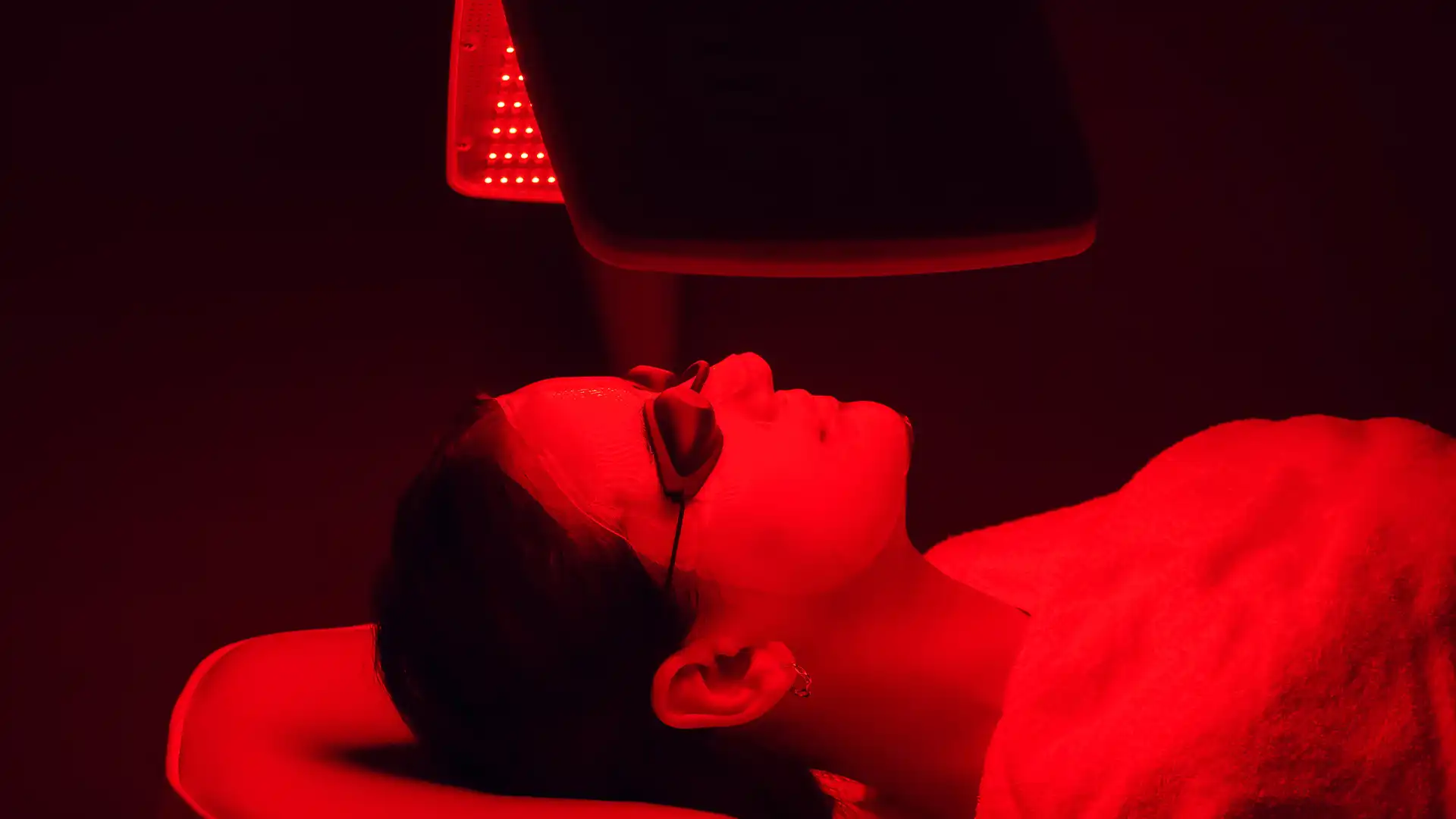
Red light therapy is a gentler option, better suited to patients who want ongoing skin support rather than a targeted fix. It’s a good fit for:
- General skin wellness and tone
- Mild inflammation
- Maintenance between more intensive treatments
- Patients seeking a low-commitment option with no downtime
Results build gradually over weeks to months of consistent use, and the treatment is safe for all skin types.
Can You Combine IPL and Red Light Therapy?
Yes. Many patients use the two together as part of a broader skincare plan. Red light therapy can help calm the skin between IPL sessions and support your results as they develop, without adding downtime. A provider can help determine the right sequencing and spacing based on your skin and goals.
IPL vs. Laser: Which Treatment Is Right for Your Skin Concern?
IPL isn’t the only light-based option, and it isn’t always the strongest one for every concern. As a general rule, IPL is the preferred choice for pigmentation and vascular concerns like sun spots, freckles, and rosacea, with minimal downtime. For deeper concerns like significant wrinkles, laxity, or scarring, an ablative or non-ablative laser typically delivers a stronger result, though with more downtime. Melasma requires particular caution across all light-based options, since certain treatments can worsen it. Your provider can help match the right technology to your specific concern during a consultation.
| Skin Concern | IPL Treatment | Ablative Laser | Non-Ablative Laser | Downtime |
|---|---|---|---|---|
| PIGMENTATION | ||||
| Sun spots/age spots | Best choice | Effective | Mild only | IPL: 5-7 days |
| Freckles | Best choice | Overkill | Mild only | IPL: 3-5 days |
| Melasma | With caution | Risk of worsening | With caution | Varies |
| Post-inflammatory hyperpigmentation | Selective cases | Not recommended | Selective cases | Varies |
| VASCULAR / REDNESS | ||||
| Rosacea / diffuse redness | Best choice | Not indicated | Limited benefit | IPL: 1-3 days |
| Broken capillaries/spider veins | Best choice | Not indicated | Not indicated | IPL: 1-3 days |
| Facial flushing | Preferred | Not indicated | Limited benefit | IPL: 1-3 days |
| TEXTURE & AGING | ||||
| Fine lines (superficial) | Effective | Stronger result | Effective | 2 days – 2 weeks |
| Deep wrinkles/significant laxity | Limited benefit | Best choice | Moderate benefit | Laser: 7-14 days |
| Rough/uneven texture | Effective | Stronger result | Effective | 2 days – 2 weeks |
| Large pores | Preferred | Effective | Effective | 1-7 days |
| SCARRING | ||||
| Acne scarring (moderate-severe) | Limited benefit | Best choice | Effective | Laser: 5-14 days |
| Surgical or trauma scars | Limited benefit | Preferred | Effective | Laser: 5-14 days |
| COLLAGEN & REJUVENATION | ||||
| Overall skin rejuvenation | Preferred | Effective | Effective | 1 day – 2 weeks |
| Collagen stimulation | Effective | Stronger result | Effective | 2 days – 2 weeks |
| SKIN TYPE SUITABILITY | ||||
| Fitzpatrick I-III (light-medium) | Both safe | Both safe | Both safe | Varies |
| Fitzpatrick IV-VI (medium-dark) | Caution/risk | High risk | Safer options | Consult required |
How Long Does It Take to See Results?
With IPL, most patients notice visible improvement after one to two sessions, with optimal results typically appearing after three to five. Red light therapy works more gradually, with changes building over weeks to months of consistent use rather than appearing after a single session.
Find Out Which Light Therapy Is Right for Your Skin
Whether you’re dealing with a specific concern like sun damage or redness, or you’re looking for a low-commitment way to support your skin long-term, our board-certified dermatologists in Annapolis can help you choose the right approach. Schedule a consultation today to build a plan suited to your skin and your goals.